The overlap is real, but so are the specialities
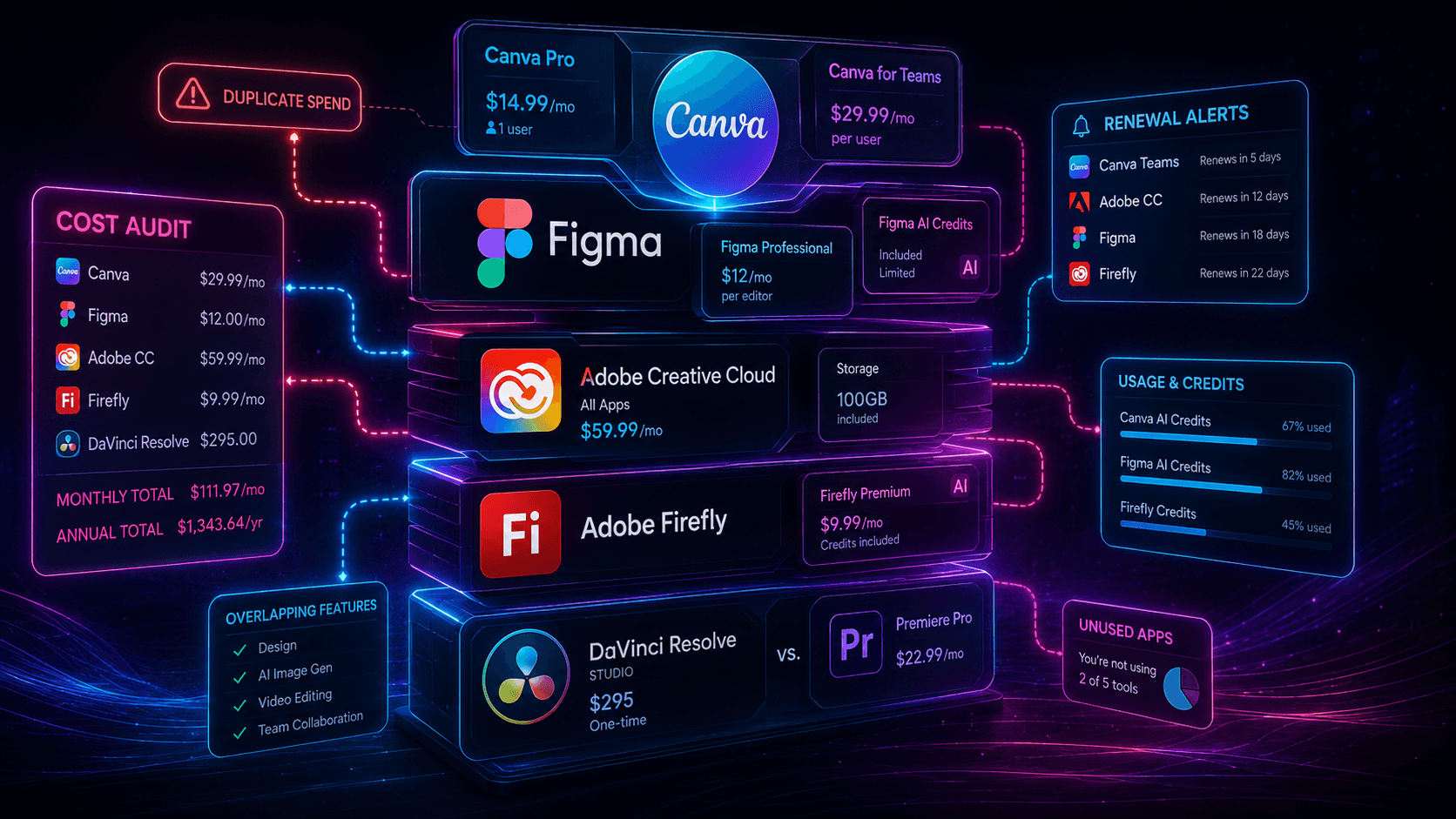
Figma, Canva and Adobe all support collaborative design and AI-assisted creation, which makes a three-product stack look wasteful. Yet each can still have a distinct role: Figma for product interfaces and prototyping, Canva for repeatable brand and campaign content, and Adobe for specialist photo, illustration, video and document work.
Duplicate spend begins when the role is described as simply ‘design’ and every creator receives every product.
Assign a primary production system
For each deliverable type, name the tool where the source of truth lives. Product screens may begin and end in Figma. Social templates may belong in Canva. Final retouching or complex motion work may stay in Adobe.
When the same asset is rebuilt in two systems, the cost is not only two licences. It is version confusion, export time and duplicated review.
Licence by task, not department
A marketing manager who edits approved templates may need Canva Business but not a full Creative Cloud seat. A product designer may need Figma and one Adobe app, not the entire Adobe suite. A brand lead may need review access across all three but full creation rights in only one.
Build role bundles from actual monthly tasks and revisit them after organizational changes.
AI credits make the stack harder to read
Figma and Adobe now attach credits to AI features, while Canva includes a growing set of AI capabilities within its plans. A team can therefore pay three times for generation capacity without knowing which system produces the approved output.
Track AI usage by deliverable and keep one preferred generation route for each content type. Experimentation can happen elsewhere, but production should have an owner.
ScoutSubs verdict
Keep all three only when Figma owns product design, Canva owns scalable campaign production and Adobe owns specialist craft. Everyone else should receive the smallest access required to review or contribute. Clear tool boundaries save more than a forced single-vendor policy.